To discover without searching. You lose something, try repeatedly to find it, and eventually give up… only to stumble upon it later while reaching for something else entirely.
In September, I began volunteering at my church. Because I’m drawn to objects with stories, my task became sorting through donations for their gift shop.
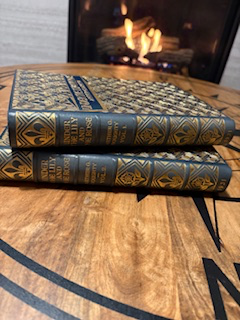
On Christmas Eve, when the displays were dismantled and refreshed, another volunteer mentioned finding two old books near the entrance. My curiosity stirred. The moment I held one of the volumes, I knew these were no ordinary books.
They were bound in soft calf leather, and trimmed in gold. The paper quality was substantial. Inside, were miniature reproductions of famous Canadian prints, each protected by tissue paper.
Under the Lily and the Rose
The awe didn’t stop there. The subject was A Short History of Canada for Children, written by a Canadian archivist, Arthur G. Doughty. Immediately, my thoughts turned to accuracy, how history is told, and to whom.
After asking several people for estimates, I made an offer that was accepted. I carried my new treasures with me through the afternoon, anticipation growing.
When I opened Volume One, my excitement deepened. The language, directed toward young readers, was thoughtful and engaging, capable of sparking genuine curiosity. The author included historical incidents I had never encountered before.
Did you know? When Cartier departed St. Malo on his second voyage, Spanish spies, hidden among the celebratory crowds, were eager to discover his destination so they could claim the land for their own king. At that moment, I could read no further. Some of the pages had never been cut. Imagine, since its publication in 1931, no one had ever read what lay between them. And if those pages remain sealed, the knowledge they hold remains inaccessible.
How do these books connect to what occupies my thoughts today, and where is this taking my writing?
What have we truly learned from the past, for ourselves and for the world we now inhabit?
We have books and archives filled with knowledge, but they are of little use if left unread. Each November, Remembrance Day calls us to reflect, yet understanding must go beyond ceremony. Perhaps those who seek public office should be required to reread history and demonstrate comprehension of its lessons before assuming responsibility.
This brings me to our present moment, a time unlike any most of us have experienced firsthand. Many have read about such periods in history books, but few expected to live within them. We have been thrust into chapters none of us wishes to reread.
It’s easy to become consumed by a negative narrative, to feel suspended in uncertainty, when living inside a stagnant cliffhanger, unable to envision a satisfying resolution. Reality television has become unnecessary, we are unpaid actors in this unfolding drama.
So how do I stay balanced?
I remind myself that I can only control what I do, not what others choose. I practice gratitude. I hold onto faith. And I return to a passage from the novel Hatchet, by Gary Paulsen.
After surviving a plane crash, a young boy is stranded alone in the Canadian wilderness with nothing but a hatchet and his will to survive. In despair, he recalls the words of his English teacher:
Perpich tells him, “You are your most valuable asset. Don’t forget that. You are the best thing you have”. In other words, you are all that you will ever have.
Despite fear, and because I am all that I have, I am reminded to bring myself into alignment with gratitude for what is present in my life. I am encouraged to model the world I wish to see: kindness, hope, love, resilience, while standing firmly in what I hold dear.
“Be the change you want to see in the world’ – Mahatma Gandhi
“Lest we forget“